
For some, the mention of ‘Oxford’ is synonymous with Inspector Morse, the fictional police detective created by the local author Colin Dexter in novels later to be made into a TV series. It’s fair to suggest that the international profile of the city was given a boost by the Morse series, which ran for thirty-three episodes on British television, from 1987 to 2000. Morse is a senior CID (Criminal Investigation Department) officer with the Thames Valley Police force in Oxford.
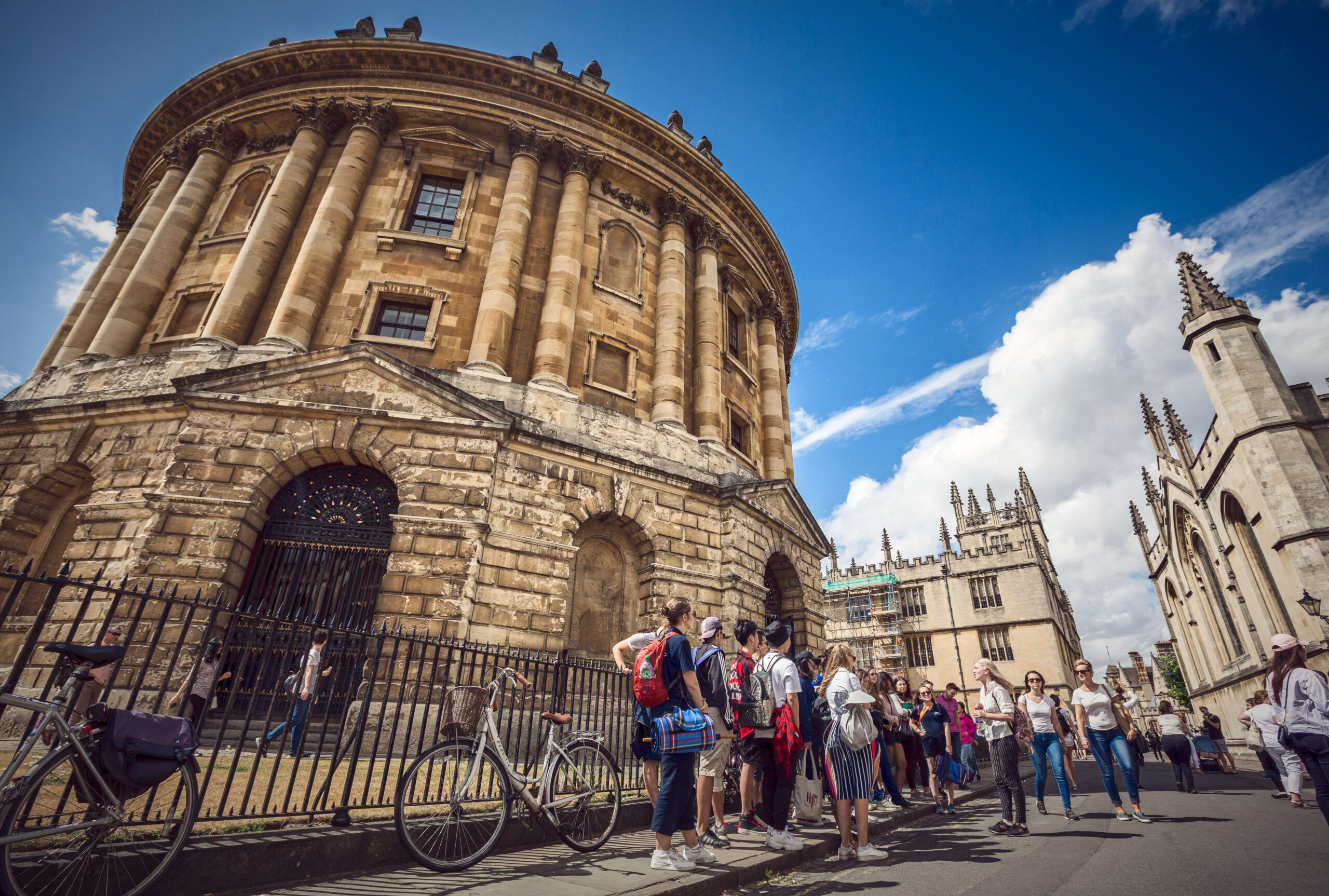
The series is set in and around Oxford, and the filming gives ample exposure to its magnificent buildings with the dramas being played out amongst them. Morse is often seen driving around the city, or enjoying a pint of ale in one of its pubs. To a local, it is amusing to see characters walking or driving along a familiar street, only to then be immediately seen in another which in reality is not in proximity. Many of the murders are set in one of the (fictitious) colleges or institutions of the city, giving the impression that Oxford is a hotbed of crime (in reality not the case!).
Morse presents a singular outlook, with a love of classical music and opera, real ale and crossword puzzles. He’s highly intelligent and somewhat pedantic, with a dislike of grammatical and spelling errors; in virtually every document he receives, he points out at least one mistake. His attitudes and prejudices make him in a sense a prime example of a middle-class English male, despite – as we learn – being the son of a taxi driver. His approach is intriguingly unorthodox, which isn’t always appreciated by his superiors, who would prefer him to operate ‘by the book’.
He drives a classic red Jaguar (in the earlier novels he drove a Lancia) and is known simply as ‘Morse’. When asked about his first name, he jokes that it is ‘Inspector’. It is actually ‘Endeavour’, which later becomes the title of a ‘prequel’ series, depicting him as a young detective constable rising through the ranks, already showing the unorthodox approach and forensic attention to detail that becomes his trademark. The name ‘Endeavour’ stems from the name of an Oxford rowing club boathouse, which the author would stroll past when walking along the banks of the Thames.
Details of Morse’s life and career are initially kept deliberately vague but slowly unfold over the course of the series. That these details are revealed piece by piece, unravelling the mystery of this private man, is one of the attractions of the series. For example, it becomes clear in one of the episodes that he’d won a scholarship to St John’s College, Oxford, but lost it due to poor academic performance as the result of a failed love affair.
His attitude towards authority and ‘the establishment’ is intriguingly ambiguous. He is portrayed as a ‘maverick’, playing by his own rules, of a kind typical of English detective stories. Similarly, he has contradictory attitudes to women. Although he is often portrayed as patronising, he also empathises with those women he meets, and even ends up dating some. Indeed the women he falls in love with sometimes turn out to be the culprit. Doomed love affairs are a feature of the enigma he presents.
Morse’s crime-solving is deductive. One of his key tenets is that “there is a 50 per cent chance that the person who finds the body is the murderer”. He uses intuition and a remarkable memory to find the killer. The ‘sidekick’, as in much crime writing, is an essential element of the stories. Morse partners with Sergeant Lewis, who shares few of the lateral thinking skills of his superior officer. Lewis is dogged and straightforward, with a more obviously stable domestic life, and unimaginative in his approach.
The creator of the Morse novels, Colin Dexter, was a Classics teacher before leaving the profession due to the onset of deafness. He became an examinations secretary in Oxford, where he stayed until he retired in 1988. He also wrote cryptic crosswords, which feature in the series. He turned to writing murder mysteries in the 1970s, and the first to include the character of Inspector Morse was ‘Last Bus to Woodstock’ in 1975. He named Morse after his friend, champion crossword setter Jeremy Morse. Dexter makes ample use of false leads and ‘red herrings’ in his plots, with the final solving of the crime being often quite unexpected.
The series features John Thaw as Inspector Morse and Kevin Whately as Sergeant Lewis. Both were known for previous TV parts (The Sweeney, Auf Wiedersehen Pet) though the Morse series gave them established fame. Dexter himself made a cameo appearance in virtually every episode, in the tradition of Alfred Hitchcock. It becomes clear during the series that Morse doesn’t enjoy the best of health, being a heavy drinker and a smoker. He is finally ‘killed off’ in 2000, during the last episode ‘The Remorseful Day’, of a heart attack. Dexter had based Morse to a large extent on himself, with similar habits and health issues, although he lived on to 2017. Sadly, Thaw only outlived the character he played by less than two years, and died in 2002.
.